
AI Engineering Case Study
FACTR: an evidence-grounded AI verification engine
By Luca Viscomi
An end-to-end AI system engineered to transform long-form speech into structured claims, retrieve supporting evidence from curated knowledge bases, and produce traceable, evidence-grounded assessments.
83%
MSc Dissertation Mark
Distinction
MSc Artificial Intelligence
109
Claims Evaluated End-to-End
6
Stage AI Engineering Pipeline
What I built
FACTR is a multi-stage AI engineering pipeline that takes unstructured, long-form conversation — a recorded debate — and turns it into structured, retrievable, and assessable knowledge. Rather than asking an LLM to simply “decide what’s true,” FACTR separates the problem into specialised stages: transcription, claim extraction, semantic representation, vector retrieval, evidence matching, and structured verification — an explainable, measurable AI workflow instead of a single opaque prompt.
I designed and engineered the complete workflow, end to end: the ingestion and transcription integration, the claim-extraction prompting and JSON schema, the embedding and retrieval layer, the evidence-matching and verification logic, the evaluation methodology, the Streamlit interface, and the Docker packaging for reproducibility.
Engineering capabilities demonstrated
Engineering Capabilities Demonstrated
🏗️ AI System Architecture
Designed a modular multi-stage pipeline connecting speech processing, NLP, retrieval, verification, and presentation layers.
🐍 Python AI Engineering
Implemented processing pipelines, data transformation, model integration, retrieval logic, and evaluation workflows.
🔎 RAG & Vector Retrieval
Built semantic retrieval using embeddings against a curated, 162k-passage domain knowledge base.
🤖 LLM Integration
Used LLMs for structured claim extraction and evidence-aware downstream reasoning, not uncontrolled free-form generation.
🎙️ NLP & Speech
Integrated long-form transcription into a downstream AI workflow, turning unstructured audio into structured, checkable text.
📊 AI Evaluation
Implemented measurable retrieval and verification evaluation — Precision@k, Recall@k, mAP — rather than relying on demos alone.
🧩 Explainable AI
Designed outputs around retrieved evidence, provenance, structured verdicts, and confidence scores, not opaque answers.
🚀 Production Thinking
Separated system concerns into discrete processing stages suitable for later API, service, and orchestration architectures.
Architecture
Verified Architecture
Six specialised stages — not one prompt asking an LLM to "decide what's true"
1. Ingest
YouTube URL → yt-dlp download → ffmpeg normalize to 16kHz mono WAV
2. Transcribe
faster-whisper (large-v2) — long-form speech to structured, timestamped text
3. Extract claims
GPT-4.1 mini, prompted to return atomic, independently-checkable claims as structured JSON
4. Embed + retrieve
sentence-transformers (384-dim) → cosine similarity over a curated 162k-passage knowledge base
5. Verify
GPT-4.1 mini, LLM-based NLI-style reasoning over retrieved evidence → structured verdict
6. Present
Streamlit — claim cards, per-tradition verdict badges, evidence provenance, feedback capture
The original project vision
Before the code, there was a design: how the pipeline was originally pitched, illustrated for a non-technical audience.
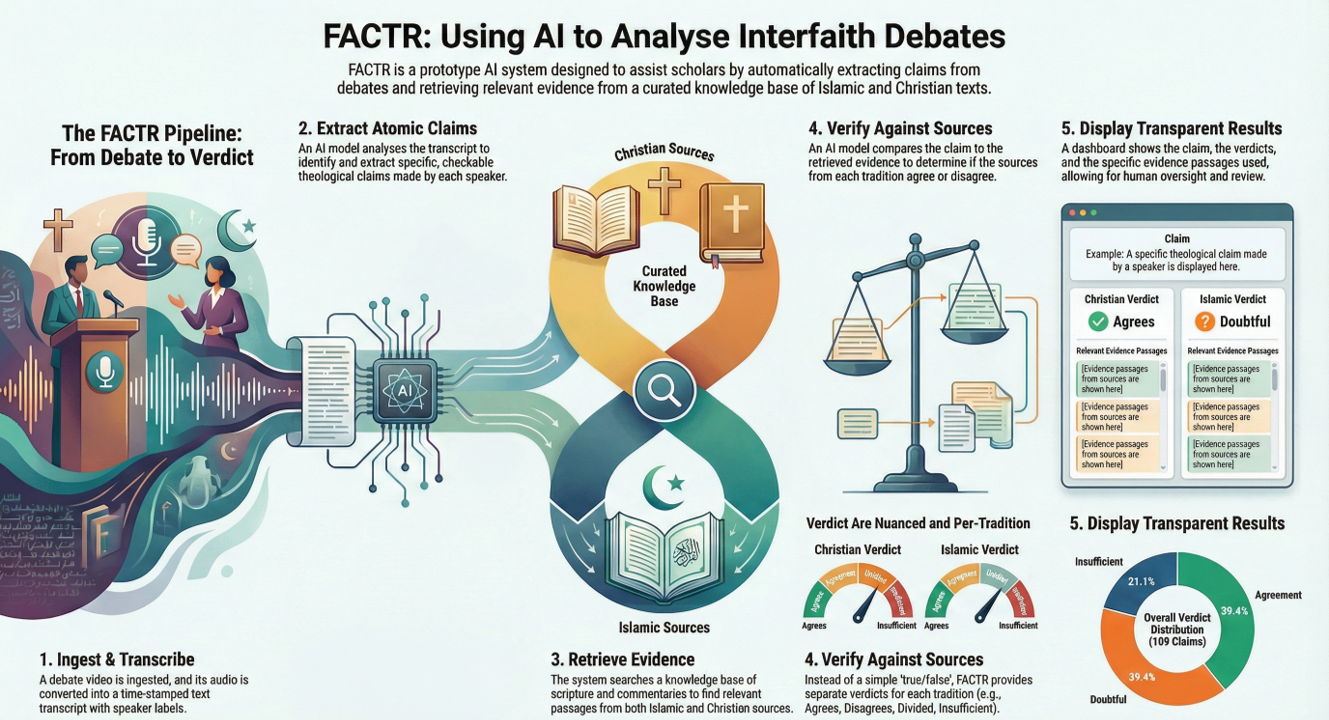
From the original project presentation materials — illustrative, not a literal spec. One example: this graphic describes “speaker labels” at the transcription stage; the verified architecture above reflects what’s actually shipped, where diarisation was scoped for a later iteration.
Engineering the pipeline
1. Long-form speech → structured transcript
Challenge. AI can’t reliably analyse a debate until spoken language has been transformed into structured, machine-readable content.
Engineering approach. FACTR integrates faster-whisper transcription directly into the pipeline, converting raw audio into timestamped, structured text ready for downstream processing.
Output. A structured transcript suitable for claim extraction.
Capability demonstrated. Speech AI integration · NLP preprocessing · pipeline engineering.
2. Unstructured text → atomic, checkable claims
Challenge. Long-form argument is full of compound, hedged, and context-dependent statements — not the kind of thing you can fact-check as a single blob.
Engineering approach. I designed a prompting and JSON-schema strategy that has an LLM (GPT-4.1 mini) extract individual, independently-assessable claims from transcript chunks, rather than reasoning over the whole transcript at once.
Output. A structured set of atomic claims, each ready to be independently retrieved against and verified.
Capability demonstrated. LLM prompt engineering · structured output design · working within model context limits.
3. Claims → retrieved, ranked evidence
Challenge. A claim is only as good as the evidence you can find for or against it — and “find” has to mean something more precise than keyword search across 162,000+ passages of scripture, hadith, tafsir, and commentary.
Engineering approach. Each claim is embedded with sentence-transformers into a 384-dimensional vector and matched against the knowledge base by cosine similarity, returning ranked, provenance-tagged evidence per tradition.
Output. Top-K evidence passages per claim, each carrying its source, tradition, and similarity score.
Capability demonstrated. RAG architecture · embeddings · semantic retrieval.
4. Evidence → structured, confidence-scored verdict
Challenge. Retrieval finds relevant evidence; it doesn’t tell you whether that evidence actually supports or contradicts the claim. Similarity is not entailment.
Engineering approach. Retrieved evidence is formatted into a verification prompt and passed to GPT-4.1 mini for LLM-based NLI-style reasoning, returning a structured verdict object — not free text.
Output. A per-tradition and overall verdict, with a confidence score and explanation, grounded in the specific evidence retrieved.
Capability demonstrated. Explainable AI design · structured LLM output · evidence-grounded reasoning.
Building the retrieval engine
FACTR’s retrieval layer is directly relevant to modern RAG engineering: claims are converted into vector representations and matched against curated, domain-specific source material with full provenance carried through to the final output.
Building the Retrieval Engine
Claim
Extracted, atomic statement
Embedding model
sentence-transformers, multilingual
384-D vector
Normalized semantic representation
Cosine similarity search
Prototyped with FAISS, shipped as direct NumPy — 162k passages fit comfortably in memory
Top-K matches
Ranked by similarity score
Evidence + provenance
Passage, source, tradition, score
Engineering beyond the prompt
The engineering value here sits in the system built around the LLM calls, not in the calls themselves. FACTR deliberately separates claim extraction, retrieval, evidence selection, and verification into distinct stages, each producing a typed, structured object rather than free-form text. Here’s the actual verdict schema a claim resolves to:
{
  "claim_id": "c_0043",
  "claim_text": "...",
  "side": "affirmative",
  "verdict_overall": "agreement",
  "verdict_islam": "agrees",
  "verdict_christian": "insufficient",
  "confidence": 0.88,
  "explanation": "...",
  "evidence_islam": ["..."],
  "evidence_christian": ["..."]
}
Every field above is a real field from the shipped VerificationRecord schema — nothing here is illustrative.
Evaluated, not just demonstrated
FACTR was built with quantitative evaluation as part of the engineering process, not bolted on afterward — measured across 109 claims using retrieval metrics, evidence-coverage analysis, and pilot feedback.
Evaluated, Not Just Demonstrated
Precision@k, Recall@k, mAP, evidence coverage, and pilot feedback — measured, not assumed
109
Claims Evaluated
93.4%
Islamic KB Evidence Coverage
97.8%
Christian KB Evidence Coverage
46%
Positive Pilot Feedback
Retrieval quality (Precision / Recall / mAP @ 10)
| Query type | P@10 | R@10 | mAP@10 |
|---|---|---|---|
| Theological assertion | 0.90 | 1.00 | 0.989 |
| Main thesis | 0.20 | 1.00 | 0.450 |
| Numerical claims | 0.00 | — | — |
Verdict distribution (n=109)
39.4%
Agreement
39.4%
Doubtful
21.1%
Insufficient
0%
Conflicted
Pilot feedback (n=10 volunteers, 146 logged interactions)
46% positive across all 146 logged interactions — 77% positive among the 87 that were explicit thumbs-up/thumbs-down reactions specifically.
Methodology note: retrieval labels are LLM-judged pseudo-gold over 3 queries on a single debate — an indicative, MSc-scope signal, not a validated benchmark.
MSc Artificial Intelligence — Distinction
FACTR formed the dissertation component of my MSc Artificial Intelligence, awarded with Distinction (dissertation mark: 83%). The work combined applied NLP, information retrieval, semantic search, LLM integration, evaluation methodology, and responsible AI design into a functioning end-to-end system.
My engineering contribution
FACTR was designed as an end-to-end engineering project. I developed the architecture, integrated the AI components, implemented the retrieval workflow, constructed the evaluation pipeline, and built the user-facing system — from the first line of ingestion code through to the Streamlit interface a pilot user actually clicked through.
Selected code
Retrieval — semantic search over the knowledge base:
def kb_search(
    query: str,
    cfg: Optional[FactrConfig] = None,
    top_k: int = 5,
    tradition: Optional[str] = None,
) -> List[KBHit]:
    cfg = cfg or FactrConfig()
    _load_kb(cfg)
    q = _MODEL.encode(
        [query],
        convert_to_numpy=True,
        normalize_embeddings=True,
    )[0].astype("float32")
    # Cosine similarity via dot product (embeddings are normalized)
    scores = emb @ q
    top_idx = np.argsort(-scores)[: top_k]
Why this matters: this layer converts a claim into a semantic vector and returns ranked evidence from independently curated source material — the retrieval core of a working RAG system.
Evaluation — the actual Precision@k / Recall@k / mAP implementation used to measure retrieval quality:
def evaluate_query(q, k=K):
    df = search(q, k=k)
    preds = df["faiss_id"].astype(int).tolist()
    gold  = set(labels[(labels["query"]==q) & (labels["relevant"]==1)]["faiss_id"].astype(int))
    hits  = [1 if p in gold else 0 for p in preds]
    p = sum(hits) / float(k)
    r = (sum(hits) / float(len(gold))) if len(gold) > 0 else None
    ap_num = 0.0; tp = 0
    for i, h in enumerate(hits, start=1):
        if h:
            tp += 1
            ap_num += tp / float(i)
    ap = (ap_num / max(1, len(gold))) if len(gold) > 0 else None
Why this matters: proves the metrics in the results section above were actually computed from a working evaluation harness, not asserted.
Reproducibility — pinning the embedding model at Docker build time to eliminate a whole class of silent dimension-mismatch bugs:
ENV FACTR_EMBEDDING_MODEL="sentence-transformers/paraphrase-multilingual-MiniLM-L12-v2"
RUN python3 -c "from sentence_transformers import SentenceTransformer; SentenceTransformer('sentence-transformers/paraphrase-multilingual-MiniLM-L12-v2')"
Why this matters: a small detail that signals production instinct — pre-baking the model into the image avoids first-run latency and, more importantly, avoids the KB and query embeddings ever silently drifting out of sync.
Engineering decisions & lessons
Similarity ≠ entailment
Semantic similarity is excellent for candidate evidence retrieval, but a highly similar passage doesn’t automatically prove or disprove a claim. Engineering response: FACTR is architected to keep retrieval and verification as separate stages, so a retrieval failure and a verification disagreement are two distinguishable, debuggable things — not one opaque failure mode.
Model consolidation over per-stage specialisation
The original design specified different models per stage (a smaller model for extraction, a larger one for verification). In practice, the shipped pipeline consolidated both stages onto GPT-4.1 mini. Engineering response: a reasonable simplification for a research-scope system — and exactly the kind of per-stage cost/quality tuning I’d revisit first in a production pass.
Retrieval floor as a tunable, not yet a gate
The retrieval layer has a configured similarity floor and a UI control for it, but production hardening means actually enforcing it in the retrieval call, not just exposing it as a tunable. Engineering response: stated plainly here as the next concrete step, not glossed over.
Diarisation, scoped for v1
Speaker-level diarisation was part of the original architecture design. The v1 build prioritised getting the full claim-extraction-to-verification path working end to end over speaker attribution. Engineering response: a scoping decision, not a gap discovered too late — and the first thing on the list below.
FACTR 2026 — how I’d engineer it for production today
FACTR proved the underlying architecture and research approach. Since completing the original system, my engineering work has expanded substantially into agentic orchestration, cloud AI platforms, API engineering, observability, and production AI patterns. If I were taking FACTR into an enterprise production environment today, here’s how I’d evolve the architecture:
Conceptual — Not Built
How I'd architect FACTR for production today
Web / Application Clients
FastAPI AI Gateway
LangGraph Orchestration
Specialised Agents / Services
Transcription · Claim Extraction · Retrieval · Evidence Validation · Verification
Model Abstraction Layer
Vector + Relational Data
Observability / Evals / Guardrails
Human Review Where Required
From FACTR to agentic AI
FACTR established practical foundations in orchestrated AI pipelines, model/tool composition, retrieval, structured state, evidence grounding, and evaluation. Those foundations now extend directly into the agentic and cloud AI platform work covered elsewhere in this series — LangGraph, Google ADK, Vertex AI, Azure AI Foundry, AWS Bedrock, and enterprise AI platform design. FACTR is where that thinking started; it isn’t where it stopped.
What FACTR demonstrates
✓ End-to-end AI system architecture ✓ Python AI engineering ✓ NLP and speech integration ✓ LLM integration ✓ RAG architecture ✓ Vector embeddings and semantic retrieval ✓ Evidence grounding and provenance ✓ Structured outputs ✓ AI evaluation methodology ✓ Explainability ✓ Responsible AI thinking ✓ Production architecture capability
Research context & limitations
FACTR’s evaluation is MSc-scope: retrieval labels are LLM-judged pseudo-gold rather than human-annotated, the retrieval benchmark covers 3 queries on a single debate, and the knowledge base — while large at 162,712 passages — reflects specific source collections rather than the full range of either tradition’s scholarship. The system also depends on a proprietary third-party model for both extraction and verification, a real dependency risk for anything beyond a research project.
Three ethical considerations stayed front-of-mind throughout: who gets to decide what counts as “supporting evidence” in a religious-claims context (a real authority and representation question, not a purely technical one), the risk of users over-trusting an AI-generated verdict on a sensitive topic, and ordinary data-protection considerations around any system that captures user feedback.
Building AI systems that go beyond the demo
My focus is engineering AI systems that combine models, data, retrieval, orchestration, and production discipline into solutions that can be understood, evaluated, and operated — not just demoed once and shelved.
Explore Agentic AI Builds · Get in Touch
Build agents. Ship impact. Stay an AgentJunky.
Subscribe to The AgentJunky AI Brief
Get practical engineering thinking on AI storage fabrics, autonomous agents, Model Context Protocol, and sovereign infrastructure delivered straight to your LinkedIn feed.
Discuss an AI Opportunity
Need an architectural review, help transitioning an agent prototype to production, or designing governed tool gateways? Let's connect.